Direct factory supply engineered for high-speed blown film, injection molding, and continuous profile extrusion.
Understanding pigment dispersion, polymer melt rheology, and non-migration principles for critical food contact environments.
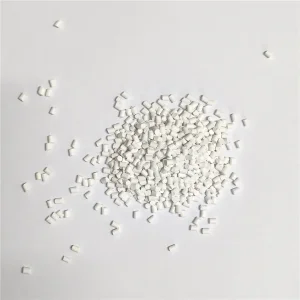
In food-grade PE white masterbatch formulation, the choice of Titanium Dioxide crystal structure determines both opacity performance and UV degradation resistance. Premium rutile $\text{TiO}_2$ possesses a higher refractive index (n = 2.73) compared to anatase ($n = 2.55$). This high refractive index delivers superior light scattering, allowing ultra-thin film packaging (down to 15 microns) to achieve complete light barrier protection without excessive pigment loading.
A primary point of failure in low-cost white masterbatches is carrier mismatch. To prevent phase separation and mechanical weakening during blown film or injection extrusion, food-grade masterbatch utilizes prime virgin Low-Density Polyethylene (LDPE) or Linear Low-Density Polyethylene (LLDPE) with a controlled Melt Flow Index (MFI) matching the target matrix (MFI 4.0 to 20.0 g/10min at 190°C/2.16kg).
Food contact compliance demands zero odor contamination and strict control over non-volatile residues. High-performance factories employ proprietary organic silane surface treatments on $\text{TiO}_2$ particles rather than low-molecular-weight waxes. This prevents migratory blooming, eliminates off-gassing during thermal extrusion, and maintains neutral flavor profiles for dairy and beverage containers.
From single-serve liquid dairy pouches to cleanroom pharmaceutical containers—tailored masterbatch formulations solving real processing challenges.
In high-speed co-extrusion blown film lines (3-layer and 5-layer), white masterbatch provides the critical opaque barrier layer protecting milk, yoghurt, and liquid egg products against light-induced oxidation. Light wavelengths between 400 nm and 500 nm cause rapid degradation of Riboflavin (Vitamin B2) and lipid oxidation in dairy products. By incorporating a high-concentration (60%-70% Rutile TiO₂) food-grade PE white concentrate into the outer layer, food processors achieve absolute opacity at thin gauges, extending shelf life without altering the film's heat-sealing window or impact strength.
Extrusion Blow Molding (EBM) of HDPE milk bottles requires white masterbatch with optimal melt strength and minimal die-buildup. Sub-standard masterbatches often leave microscopic inorganic agglomerates that cause pinholes, stress cracks, or neck-finish leaks. Food-grade white concentrates manufactured with dual inorganic alumina-silica surface coatings ensure smooth melt processing across high-cavity automated bottle lines, maintaining uniform wall thickness, high stiffness, and pristine whiteness ($L^* > 96$, $a^* = -0.5$, $b^* = 1.2$).
Injection molding of food-contact caps, closures, and disposable tableware requires masterbatch with superior flow characteristics and zero warp distortion. High pigment loading can trigger anisotropic shrinkage in semicrystalline PE, causing cap leakage. Optimized food-grade PE white masterbatches utilize non-nucleating dispersing additives that preserve linear mold shrinkage parameters, ensuring leak-tight seals on beverage bottles while maintaining FDA 21 CFR compliance.
Beyond food, medical-grade compliance (USP Class VI, ISO 10993) requires ultra-pure PE white masterbatches free from heavy metal catalysts, phthalates, and Polycyclic Aromatic Hydrocarbons (PAHs). Applications include blister pack backing films, diagnostic test strip housings, and pharmaceutical pill bottles where ultra-low extractables and leachables are mandatory.
Pioneering next-generation polymer additives: PFAS-free processing aids, circular economy compatibility, and sub-micron TiO₂ dispersion.
With global regulatory bans on Per- and Polyfluoroalkyl Substances (PFAS) expanding across North America and Europe, leading Chinese masterbatch factories are transitioning to non-fluorinated processing aids. Next-generation food-grade white PE masterbatches incorporate silicone-based and ester-based lubricants that eliminate melt fracture (sharkskin) and melt pressure spikes during high-output film extrusion without relying on legacy fluoropolymers.
In automatic plastic recycling facilities, traditional dark or heavily filled plastics are difficult for NIR optical sorters to categorize. Advanced white masterbatches are engineered with specific optical reflectance profiles that allow automated sorting systems to immediately recognize Post-Consumer Recycled Polyethylene (PCR-PE) streams, supporting closed-loop circular packaging economies.
The continuous pursuit of cost reduction without performance compromise is driving masterbatch loading limits from 60% up to 75-80% active TiO₂. Utilizing high-torque triple-screw extruders and nanometer-scale organic dispersion agents, modern plants achieve complete particulate de-agglomeration down to 200–300 nanometers, dramatically lowering freight costs per unit of opacity.
Analyzing the chemical cluster synergy, automated manufacturing scalability, and rigorous quality control in Changzhou, Jiangsu.
Located in Changzhou, Jiangsu, plastic masterbatch manufacturers benefit from direct geographical proximity to world-class petrochemical refineries (providing virgin LLDPE/LDPE carrier resins) and titanium dioxide production facilities. This localized raw material ecosystem eliminates long-distance inland freight premiums, securing low raw material input costs.
Modern Chinese factories utilize fully automated loss-in-weight gravimetric feeders coupled with high-speed co-rotating twin-screw extruders. Continuous melt filtration systems ($100-mesh$ to $320-mesh$ automated screen changers) ensure that zero undispersed scale or foreign contaminants enter the final pelletized product, maximizing yield and lowering labor overhead.
The term "Cheap" in Chinese B2B masterbatch manufacturing does not mean compromised quality. Instead, it reflects immense operational scale, high machinery throughput (tons per hour per line), and optimized energy consumption. By distributing fixed overhead over high export volumes to 100+ countries, factories offer ultra-competitive FOB prices while strictly maintaining food-contact compliance certifications.
Verifying compliance parameters across key global destination markets for plastic food packaging materials.
| Regulatory Standard | Jurisdiction | Key Testing Parameters | Allowed Materials & Thresholds | Jiazhou Product Compliance Status |
|---|---|---|---|---|
| FDA 21 CFR 177.1520 | United States / Global | Olefin polymer extractable fractions in n-hexane & xylene | Maximum extractable fraction < 5.5% at 50°C | Fully Certified (Zero non-approved additives) |
| EU Regulation No 10/2011 | European Union | Overall Migration Limit (OML) & Specific Migration Limits (SML) | OML < 10 mg/dm² of plastic surface; SML for Heavy Metals | Fully Certified (Tested in 3% Acetic Acid & 10% Ethanol) |
| GB 4806.6-2016 | China National Standard | Food contact plastic resins, sensory testing & heavy metal migration | Lead ($\text{Pb}$) < 1 mg/kg, Cadmium ($\text{Cd}$) < 1 mg/kg | Fully Certified (Pristine Virgin Carrier Resin) |
| RoHS Directive 2011/65/EU | Global / Electronics & Packaging | Heavy metals (Pb, Cd, Hg, Cr VI) & Phthalates (DEHP, DBP, BBP, DIBP) | Combined Heavy Metal Concentration < 100 ppm | Fully Certified (SGS / Intertek Test Verified) |
| REACH (EC 1907/2006) | European Union | Substances of Very High Concern (SVHC) screening | Zero SVHC ingredients above 0.1% w/w threshold | Fully Certified (Compliant with latest SVHC candidate list) |
Direct answers to critical questions regarding let-down ratios, dispersion quality, thermal performance, and global logistics.
The optimal Let-Down Ratio depends on the active Titanium Dioxide concentration of the masterbatch and the target film thickness. For a 60% or 70% Rutile $\text{TiO}_2$ white masterbatch used in standard milk film or retail carrier bags (25–50 microns), an LDR between 1.0% and 4.0% is typically recommended. For ultra-thin films requiring intense opacity or UV barriers, LDR can be adjusted up to 6.0% without adversely affecting melt pressure or film heat-sealing strength.
Odor contamination in polyolefin packaging stems from low-molecular-weight polymer degradation products, unreacted organic waxes, or low-purity dispersants exposed to thermal shear. We utilize 100% prime virgin LLDPE/LDPE carrier resins combined with high-purity organic silane surface treatments. Production extrusion temperatures are precisely managed via multi-zone PID controllers to eliminate thermal oxidation, ensuring that our white masterbatches pass strict Robinson Sensory Test evaluations for taste and smell neutrality.
Industrial white masterbatches often use anatase $\text{TiO}_2$ or mineral extenders ($\text{CaCO}_3$, Talc) coated with low-cost paraffin waxes or heavy-metal-containing stearates. In contrast, food-grade white masterbatch strictly uses high-purity Rutile $\text{TiO}_2$, heavy-metal-free additives, and virgin carrier resins certified under FDA 21 CFR 177.1520 and EU No 10/2011. Furthermore, food-grade masterbatches undergo rigorous heavy metal analysis (EN 71-3) and overall/specific migration testing.
Yes. Our high-concentration food-grade white masterbatches are formulated with thermal stabilizers and non-volatile dispersants that withstand continuous extrusion temperatures up to 260°C to 280°C without color yellowing, thermal degradation, or die-lip buildup (lacing). This high thermal ceiling makes them ideal for cast film co-extrusion, high-speed extrusion coating, and thin-wall injection molding.
All masterbatches are packaged in 25 kg heavy-duty moisture-proof PE woven bags or aluminum-foil moisture barrier bags, stacked on standard export pallets and shrink-wrapped. To prevent moisture absorption (which causes lacing/bubbles during film extrusion), pellets should be stored in a cool, dry warehouse away from direct sunlight. Unopened bags have a guaranteed shelf life of 12 months.
Premium color solutions, functional additives, and cost-reducing filler masterbatches available for immediate international shipping.