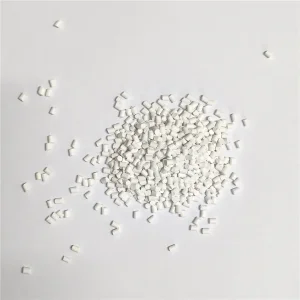
Engineered for extreme dispersion, high thermal resistance (260°C+), and strict regulatory food contact compliance.
Understanding the technical rigor, market demands, and chemical compliance driving modern polyolefin masterbatch manufacturing.
Key Insight: Achieving food-grade certification is not merely a matter of using pure raw materials; it demands complete control over Non-Intentionally Added Substances (NIAS), heavy metal contamination (<100 ppm total combined Pb, Cd, Hg, Cr VI), low volatile organic compound (VOC) generation, and non-migratory antioxidant stabilizer packages.
Deconstructing the physics of light scattering, pigment surface chemistry, and melt index matching.
Mie scattering theory dictates that maximum light scattering for visible wavelengths (λ = 400–700 nm) occurs when TiO₂ crystallite size is controlled precisely between 0.20 and 0.30 microns. Oversized agglomerates create surface pinholes, reduce film tear strength, and diminish opacity.
Raw TiO₂ surfaces contain active hydroxyl groups capable of catalyzing polymer degradation under high thermal shear. High-grade masterbatches employ hydrophobic surface treatments (Al₂O₃, SiO₂, and silane/polyorganosiloxane coupling agents) to prevent moisture adsorption and eliminate lacing in thin films.
The carrier resin—typically Low-Density Polyethylene (LDPE) or Linear Low-Density Polyethylene (LLDPE)—must feature a closely matched Melt Flow Index (MFI) relative to the target substrate resin. This ensures zero interfacial viscosity mismatch during high-speed extrusion.
The Lacing Phenomenon in Blown Film: Moisture entrapment or chemical volatilization at high extrusion temperatures (>220°C) causes microscopic voiding known as "lacing" or "pinholing" in cast or blown packaging films. China's top masterbatch manufacturers combat this by operating automated desiccant conditioning and vacuum degassing systems during twin-screw compounding.
Demonstrating 16+ years of operational experience, authoritative testing protocols, and global compliance credentials.
Every food-grade batch produced is formulated to strict international standards, passing rigorous testing for US FDA 21 CFR 178.3297 (Colorants for Polymers), EU Commission Regulation No 10/2011 (Plastic materials intended to come into contact with food), and China's GB 4806.6 / GB 9685 standards.
To guarantee filterability and fine dispersion in modern multi-layer film equipment (preventing screen pack clogging and film breaking), masterbatch batches undergo stringent FPV testing (EN 13900-5), maintaining values strictly below 0.5 bar/g TiO₂.
Raw materials undergo ICP-MS spectrometry analysis to verify non-detectable levels of heavy metals (Lead, Cadmium, Mercury, Hexavalent Chromium), Primary Aromatic Amines (PAAs), Phthalates, Bisphenol A (BPA), and non-migratory fluorescent whitening agents.
Tailored formulations optimized for blown film, blow molding, injection molding, and extrusion laminating.
Multi-layer co-extrusion films (3-layer, 5-layer, 7-layer) require ultra-high opacity white layers to protect light-sensitive nutrients (Riboflavin/Vitamin B2) from photo-oxidation. High TiO₂ concentration PE white masterbatches provide complete UV light barrier (<0.1% light transmission at 400nm) while maintaining seal integrity.
Thin-wall food packaging containers, beverage caps, and margarine tubs demand high melt-flow white masterbatches that do not induce warpage or structural dimensional instability. Formulations are tuned for high isotropic shrinkage behavior and fast cycle times.
Used in paperboard liquid packaging (Tetra Pak style containers) and flexible barrier pouches. Requires zero degradation at ultra-high processing speeds and temperatures reaching up to 300°C–315°C without generating smoke, odor, or micro-pinholes.
Direct technical comparison illustrating why food-grade masterbatch requires elevated formulation standards.
| Performance Parameter | Standard Industrial White Masterbatch | High Concentration Food Grade White PE Masterbatch |
|---|---|---|
| TiO₂ Type & Quality | Anatase or Low-Grade Rutile (Sulfated Process) | Premium Chloride Process Rutile (93%+ Purity) |
| TiO₂ Loading Content | 30% – 50% | 60% – 80% High Concentration |
| Carrier Resin Grade | Recycled or Off-spec PE Resins | 100% Virgin Food-Contact Certified LLDPE/LDPE |
| Heavy Metal Compliance | Basic RoHS (<1000 ppm) | Strict Compliance: Total Combined <100 ppm |
| Filter Pressure Value (FPV) | > 2.0 bar/g | < 0.5 bar/g (Ultra-High Dispersion) |
| Thermal Stability Range | Up to 220°C | 260°C – 300°C (Zero Lacing / Smoke) |
| Regulatory Standards | Non-food compliant | FDA 21 CFR 178.3297, EU 10/2011, GB 4806 |
Pioneering sustainable, bio-compatible, and smart additive colorant integration for next-generation packaging.
Integration of sugarcane-derived Bio-PE and ultra-purified Post-Consumer Recycled (PCR) polyolefin carriers compliant with European circular packaging mandates.
Complete phase-out of fluoropolymer-based Polymer Processing Aids (PPA), replacing them with food-contact approved bio-siloxane and synthetic wax dispersion aids.
Real-time inline spectrophotometric dosage control during extrusion, dynamically maintaining Delta E values under 0.15 regardless of base resin color fluctuations.
Next-generation surface-engineered TiO₂ nanocomposites allowing opacity equivalence at 30% reduced pigment mass, significantly lowering carbon footprint.
Addressing key procurement, technical specification, and compliance inquiries from global buyers.
A food-grade white PE masterbatch must be formulated strictly using virgin food-approved polyolefin carrier resins and high-purity Rutile Titanium Dioxide listed under positive lists such as FDA 21 CFR 178.3297 or EU Regulation 10/2011. Furthermore, all secondary additives (antioxidants, dispersion aids) must be non-toxic, heavy-metal-free, and show overall/specific migration test values well below global regulatory thresholds.
High concentration masterbatches (70%–80% Rutile TiO₂) allow processors to achieve desired whiteness and opacity at significantly lower Let-Down Ratios (LDR, typically 1% to 3%). This lowers freight costs per kilogram of active pigment, reduces storage space requirements, minimizes carrier resin dilution effects on target polymer mechanical properties, and improves processing economics.
Chloride-process Rutile has a substantially higher refractive index (2.73) compared to Anatase (2.55), resulting in superior light scattering and opacity per unit mass. Additionally, Rutile is far less photo-reactive, providing significantly better resistance to UV-induced yellowing and polymer chain degradation in outdoor packaging applications.
Leading Chinese manufacturers like Changzhou Jiazhou utilize computerized spectrophotometers to measure color parameters (CIE L*a*b* values) under standard illuminants (D65). Batches are approved only when total color difference (Delta E) is maintained under 0.3 relative to the target standard. Filter Pressure Value (FPV) testing is simultaneously conducted to verify melt dispersion quality.
While PE carrier masterbatches can sometimes be processed in Polypropylene (PP) at low addition rates due to chemical compatibility within polyolefins, it is recommended to use specialized universal or PP-carrier masterbatches for high-performance applications to prevent phase separation or mechanical property loss. PE carriers are generally incompatible with Polystyrene (PS) or PET matrices.
Masterbatch bags should be stored in a cool, dry, well-ventilated warehouse away from direct sunlight, rain, and heat sources. Bags should remain sealed until use to prevent moisture adsorption on the pigment surface, which could otherwise lead to lacing or bubble formation during high-temperature extrusion.
Explore our full line of non-toxic, heat-resistant, anti-migration color and special effect masterbatches.