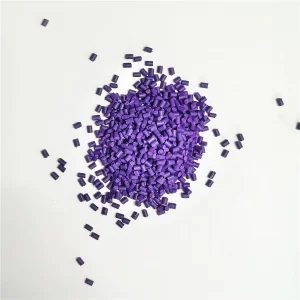
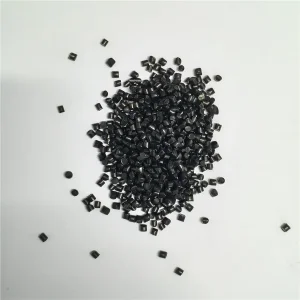
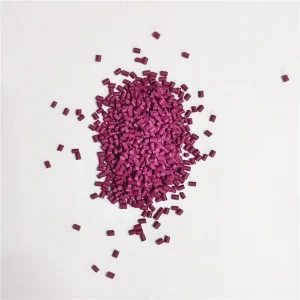
Direct Factory Supply for Blown Film, Injection Molding, Extrusion, and Technical Polymers
Understanding the Chemistry, Optical Physics, and Rheological Optimization in Modern Thermoplastic Extrusion
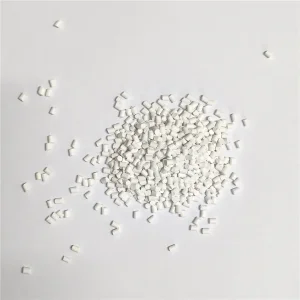
In modern industrial plastic converting, achieving consistent, high-opacity whiteness without compromising the mechanical integrity of polyolefin matrices represents a complex chemical challenge. High Whiteness White PE Masterbatch serves as an indispensable additive for flexible packaging, agricultural films, rigid containers, and technical extrusions. The core visual brightness is driven by high-purity Titanium Dioxide (TiO₂), predominantly in the rutile crystal structure, dispersed systematically into low-density polyethylene (LDPE), linear low-density polyethylene (LLDPE), or high-density polyethylene (HDPE) carriers.
Rutile TiO₂ is specified due to its elevated refractive index (2.73 compared to anatase's 2.55), superior light-scattering efficiency, and high UV absorption capacity. At Changzhou Jiazhou Plastic Products Co., Ltd. (operating with over 16 years of direct manufacturing experience), formulating high-whiteness masterbatch involves balancing TiO₂ loading—typically ranging from 40% up to 75% by weight—with carrier resin melt flow indexes (MFI) and proprietary surface treatment chemistry (silane coupling agents and organic wetting compounds). This ensures complete pigment deagglomeration, minimal filter pressure values (FPV), and zero die build-up during high-speed extrusion processes.
Rutile TiO₂ provides maximum opacity, weather resistance, and thermal endurance up to 300°C. Advanced surface treatment with Alumina (Al₂O₃) and Silica (SiO₂) prevents photo-catalytic degradation in outdoor applications.
Matching the Melt Flow Index (MFI) of the PE carrier to the target virgin polymer prevents phase separation, skinning, melt fracture, and structural weakening in ultra-thin blown films down to 8 microns.
To counteract natural polymer yellowing, trace optical brighteners (OB-1) and ultramarine blue toners are precisely metered to maximize CIE Whiteness index (WI) values above 95 under D65 illuminant conditions.
Inside Jiazhou Plastic’s 6,000 m² Automated Compounding Plant in Changzhou, China
| Performance Metric | Standard Grade Masterbatch | Jiazhou High-Whiteness Premium PE Grade | Test Method Standard |
|---|---|---|---|
| TiO₂ Content (Rutile) | 40% - 50% | 60% - 75% High Loading | ISO 3451-1 (Ash Content) |
| Melt Flow Index (MFI) | 2.0 - 10.0 g/10min | Customizable 0.5 - 45.0 g/10min | ASTM D1238 / ISO 1133 |
| Filter Pressure Value (FPV) | > 1.5 bar/g | < 0.5 bar/g (Ultra-Fine Dispersion) | EN 13900-5 |
| Heat Resistance | 220°C - 240°C | Up to 300°C Non-Yellowing | DIN EN 12877-2 |
| Light Fastness (Blue Wool Scale) | Grade 5 - 6 | Grade 7 - 8 (Maximum UV Stability) | ISO 105-B02 |
| Heavy Metals & Toxicants | Basic Compliance | RoHS 3.0, REACH SVHC, FDA 21 CFR Compliant | ICP-OES / GC-MS Testing |
The manufacture of high-concentration white masterbatch demands extreme mechanical shear, controlled thermal history, and effective degassing. Jiazhou utilizes multi-zone co-rotating twin-screw extruders featuring L/D ratios of 44:1 to 48:1. Liquid injection of organo-silanes combined with gravimetric loss-in-weight feeders guarantees raw material dosage accuracy within ±0.2%. This structural setup ensures pigment agglomerates are broken down to their primary particle size (typically 0.2 to 0.3 microns), maximizing light reflectance while preventing line-breakage in film blowing.
How Technical Masterbatch Selection Directs Margin Optimization for Overseas Resin Converters
By increasing rutile concentration to 70% or 75% with superior dispersion, converters can drop dosage rates from 5% to 1.5%-2.5%. This significantly lowers volumetric shipping freight, warehouse footprint, and masterbatch consumption per ton of finished resin.
Un-dispersed TiO₂ aggregates cause filter clogging, frequent screen-pack changes, and die lip build-up. Jiazhou's FPV-tested white masterbatch extends screen pack life by up to 300%, eliminating unplanned downtime on high-speed casting lines.
Poor quality carrier resins or uneven pigment distribution induce stress concentrations, leading to dart-impact failure in heavy-duty sacks. Our formulations maintain polymer chain entanglement, protecting tear strength and burst resistance.
For a converter processing 5,000 Metric Tons of PE packaging film annually, switching from a 50% TiO₂ masterbatch (dosed at 4%) to a Jiazhou 75% High-Whiteness masterbatch (dosed at 2.33%) reduces masterbatch consumption by 83.5 MT per year. Factoring in reduced freight, fewer screen changes, and lower scrap rates, average net manufacturing operational costs decrease by 12.8% to 16.5% annually.
Strategic Upstream Integration, Cluster Logistics, and 16-Year Manufacturing Reliability from Changzhou
Situated in Jiangsu Province, Changzhou Jiazhou maintains direct, long-term procurement contracts with Asia’s premier titanium dioxide manufacturers (Sulfate and Chloride routes). This shields global buyers from volatile spot-market price spikes.
Proximity to Shanghai Port and Ningbo Port enables seamless ocean freight booking, optimized container loading, and accelerated customs processing—enabling rapid 15-day average order lead times.
Operating dedicated twin-screw extrusion lines running 24/7 yields significant economies of scale. Production overheads are minimized without compromising QC testing or batch tracking standards.
Flexible manufacturing arrangements accommodate custom pellet shapes (micro-pellets vs. standard granules), specialized moisture-barrier packaging (25kg foil-lined bags, Gaylord boxes, or 1-ton jumbo bags).
Meeting Rigorous Environmental, Health, and Safety Directives Across European, American, and Asian Markets
Our White PE Masterbatch formulations utilize additives strictly listed under FDA 21 CFR 177.1520 and EU Regulation (EU) No 10/2011. Heavy metals such as lead, cadmium, mercury, and hexavalent chromium are non-detectable under ICP-OES standards, guaranteeing safety in food wrap, dairy pouching, and beverage closures.
All masterbatch products exported to the European Economic Area (EEA) are fully certified under REACH SVHC (Substances of Very High Concern) and compliant with Directive 2011/65/EU (RoHS 3). They contain zero phthalates, bisphenol A (BPA), or polybrominated diphenyl ethers (PBDEs).
Jiazhou provides global technical assistance for process optimization. Our technical team works alongside clients in Southeast Asia, the Middle East, Africa, and South America to resolve issues such as processing yellowing, die drag, filter blockage, or uneven opacity.
Formulated for Tailored Performance Across Diverse Processing Techniques and Final Product Demands
Scenario: Milk packaging, courier bags, hygiene backsheet films, and multi-layer food barrier pouches (3-layer / 5-layer / 7-layer ABA & ABC lines).
Key Performance: High opacity at thin gauges (<15 microns), pinhole prevention, exceptional hot-tack and sealability, non-migratory slip additive balance.
Scenario: Medical disposables, syringe plungers, cosmetic closures, caps, crates, and household appliance housings.
Key Performance: Zero dimensional warping or shrinkage differential, high gloss finish, low odor/taste transfer, rapid cycle time retention.
Scenario: Greenhouse covers, white-black agricultural mulch film, silage stretch film.
Key Performance: High solar heat reflection, anti-UV degradation, chemical resistance to pesticides/sulfur, long outdoor durability (12-36 months).
Sustainable Polymers, Circular Economy Integration, and Smart Manufacturing Trajectories
As global brand owners commit to incorporating Post-Consumer Recycled (PCR) PE resins, white masterbatches must overcome inherent gel contaminants, dark specks, and yellowness in recycled feedstocks. Jiazhou's next-gen masterbatches include built-in antioxidant packages and melt-homogenizers designed to uplift PCR aesthetic properties to near-virgin quality.
In response to global single-use plastic restrictions, our R&D unit has developed high-whiteness masterbatch lines using bio-based polyethylene derived from sugarcane, as well as compostable carriers (PBAT/PLA), ensuring full compliance with EN 13432 and OK Compost standards.
Transitioning from traditional manual color matching to automated AI spectrophotometry allows Jiazhou to establish exact CIELAB color coordinates for custom customer samples within 24 hours, ensuring zero metamerism across varying factory lighting environments.
In-Depth Answers to Critical Sourcing, Engineering, and Processing Questions
Direct Factory Supply with Global Shipping & Custom Color Matching Technical Support